IRIS ICHISHITA: There's so many different ways to try and understand this text. And there are so many different pieces of evidence that point us in these different directions. Is it fan fiction? Is it pirated fiction? Is it pastiche? Is it creative licence, creative liberty? Is it an alternate version? Could it have been Bram Stoker's original version, his director's cut? What are these texts in relationship to each other?
HZ: Well, they are first cousins, I'd say?
IRIS ICHISHITA: Yeah, yeah. If not shadowy twins.
HZ: Maybe it's more like identity theft.
Allusionist 208. Four Letter Words: Four Letter Words: Ffff

If you’re thinking, “How the fuck can you write a whole 500-page dictionary just about the word ‘fuck’?” consider, say, the many meanings of ‘ass fuck’, noun and verb - and that’s before you even add similar terms like ‘bumfuck’ and ‘buttfuck’. And there are so many less usual terms, like ‘fucksome’ or ‘fuckstrated’ or ‘fuckist’ or ‘fucktious’.
Read moreAllusionist 168 Debuts transcript

HZ: The work that RFSU does has included, over the past three decades, coming up with new terms, to fill gaps in the vocabulary or provide more options for talking about sex and bodies.
KALLE ROCKLINGER: Sometimes it's to highlight or make something visible that's not been really talked about. Sometimes it's to change norms in society in some ways, and sometimes it's been sort of a really strategic choice for us in our political work to refuse a certain term or way of describing things, to tell another story, so to speak.
Read moreAllusionist 151 The Bee's Knees transcript
“There's a town in Quebec called Saint-Louis-du-Ha! Ha!, which apparently has the Guinness World Record for most exclamation marks in a town name. Which is two.”
Read moreAllusionist 145 Parents transcript

FREDDY McCONNELL: A lot of the time when you hear about trans and non binary inclusion in pregnancy care, the idea is that all of this inclusive stuff is additive. It's not meant to replace language that works for the vast majority of people who are pregnant, which are cis women; it's just this is the language you use if and when you do encounter someone who's trans.
Read moreAllusionist 144 Aro Ace transcript

HZ: How did it feel when you found the vocabulary to explain yourself?
LEWIS BROWN: Oh, it was so good. I think it's maybe a bit of a cliche to say, but it was like I'd found a puzzle piece. And I was like, "Oh! That makes sense. Right. Yeah. You know, that checks out." It really helps, I think, to have to have a term for it. Before I had words like aromantic and asexual, I don't know, I just had a bad feeling. When I assumed that I did feel attracted to other people and I was kind of thinking, do I just have some trauma or something? Am I just a selfish person? And these are a cruel things to be thinking about yourself. And then I was like, oh, wait, no, no I don't. I can think of all the ways in which I'm a pretty giving person. I care about the people that I care about quite a lot. Just not necessarily in the way that everyone thinks is the most important way.
Read moreAllusionist 128 Bonus 2020 transcript
KATE LISTER: When you're looking back at old texts and they're talking about 'slut holes' that need clearing out, it makes us fall about laughing; but what they actually mean was like a hole that was just full of rubbish and crap in the street, that you'd put coal into and store there. And there's something that was called ‘slut wool’ as well. You know when you lift up the sofa or the bed and you call them dust bunnies now, all those balls of dust - that was ‘slut wool’ once upon a time.
Read moreAllusionist 124 Nightmare transcript
Around 700 years ago, the word ‘haunt’ first appeared in written English, at least 200 years before it took on the meaning of a ghost frequenting a place.
HZ: It just meant that way where someone haunts a bar, as in they go to it a lot, but they're not an actual ghost. But it also meant to have sex with. And I could not do enough Googling safely to find out why it had that sense, because it just came up with a lot of websites about people having sex with ghosts. So I cannot find the etymology of this middle English use of 'haunt' in the sexual sense.
PAUL BAE: You've just screwed up your Google ads logarithm by looking up succubus, haunting, "Why sex haunting?"
HZ: The things I do for this show.
PAUL BAE: Exactly.
Allusionist 121 No Title transcript
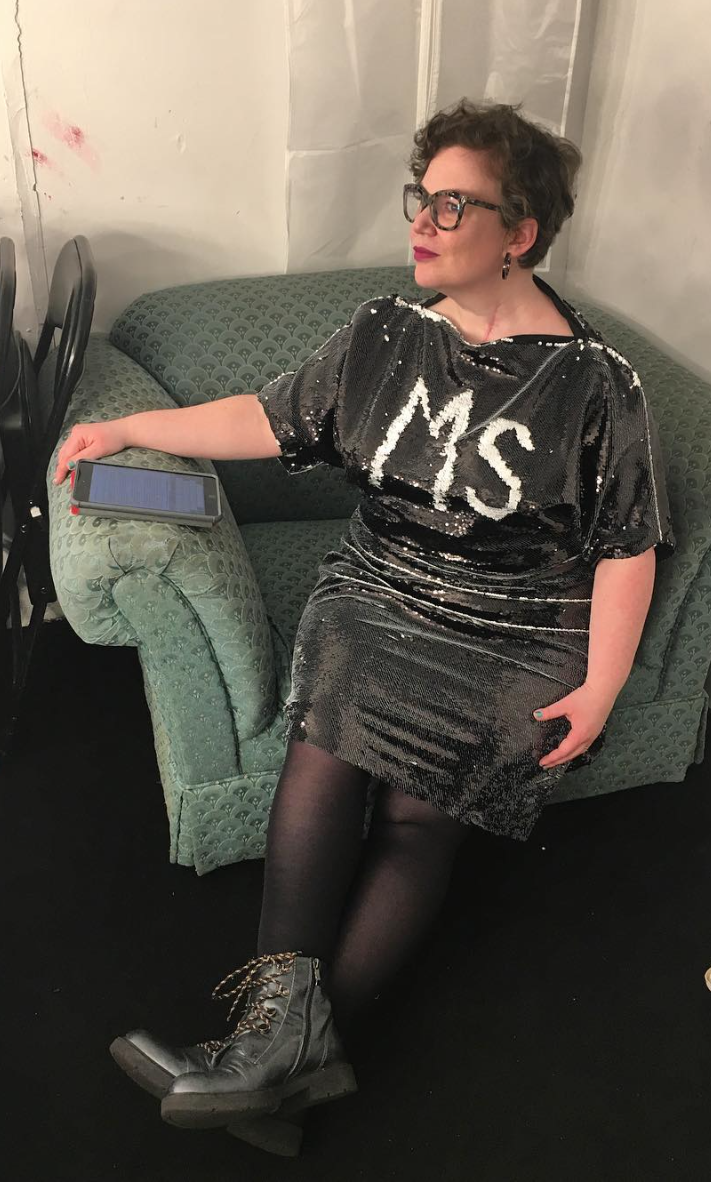
About to go onstage to perform No Title for the first time, at SF Sketchfest 2019 at the Brava Theatre in San Francisco. Photo by Martin Austwick.
The bank clerk scrolls down and down this list of titles and honorifics, this enormous list of different ways to present ourselves, and I just want an option that doesn’t reflect my marital status, because why did all the available male titles not reflect marital status whereas female ones did? And come to think of it, why do titles reflect gender anyway? Why does anything reflect gender? What is the point of gender?
I was asking a question I am not intelligent enough to answer. And I wasn’t expecting this moment, in the bank, on a seemingly trivial and pointless mission, to be my introduction to gender studies and queer theory, but you don’t necessarily get to choose the learning moments of your life.
And in case you’re sitting there thinking, “Well. If if it’s SO important to you to have a title that does not reflect your marital status or your gender, why don’t you just become a rabbi?” Well, my family lapsed HARD. None of us is becoming a rabbi. We’d never make it. They can see the bacon in our eyes.
Read moreAllusionist 118 Survival: Bequest transcript

ELIZABETH KEREKERE: I'm so convinced that transphobia, biphobia, homophobia are such an integral part of colonisation, I reject that as a colonial construct, I reject it as racist.
As they took our land - tried to take all of our land, tried to take all of our language and suppress our culture, they also took our expressions of sexuality and gender. And that is important to us in a core part of our culture, especially because the way that the institutional racism, the intergenerational trauma that is the legacy of colonisation has impacted on us and the levels of discrimination against people with diverse genders, sexualities and sex characteristics, that we see that all of this, all of this was a massive attempt to cover up what was already there and pretend it never happened.
Allusionist 116: My Dad Excavated a Porno transcript
HZ: The Victorians really did a number on people. I feel like we're still unpicking Victorian attitudes.
KATE LISTER: Yes, we are. I mean, we're still very much the children of the Victorians, and they're a fascinating bunch, the Victorians. No generation, at no point in history, has sex been successfully repressed, ever. It just doesn't happen. But what you have is really strict social morality, conditioning and mores and constructs and power dynamics around sex that dictate what we are and what we're not supposed to be doing. And outward facing, they were so repressed and polite society and so offended by everything even remotely to do with sex, to the point of where they wouldn't say the word 'trousers' because they thought they were too rude. They were 'sit down upons'.
Read moreAllusionist 101. Two or More - transcript
MARK WILKINSON: If you talk about something a certain way for enough time over a sustained period of time then it will likely affect the way people perceive that issue, right? So if something is framed in a certain way over a sustained period of time, you always hear the same words for something, then eventually it frames the way you think about it.
HZ: In this case, he’s been studying the use and framing of the word ‘bisexual’.
MARK WILKINSON: I think bisexual - the word bisexual, and the people as well - the word has had a really rough go of it.
Read moreAllusionist 56+12. Joins & Pride - transcript

To celebrate Pride Month, I’m playing two of the Allusionist episodes that have stuck with me the most during the show’s existence.
Read moreAllusionist 99. Polari - transcript

HZ: In 1982, Princess Anne, the second child of the Queen of England, Olympic Equestrian, is competing at the Badminton Horse Trials.
PAUL BAKER: She's jumping over all these obstacles and oops, she slips and falls in the water off an obstacle. And all of the photographers rush forward to take a photograph, and she tells them to "naff off". Or "naff orf".
HZ: She's not allowed to drop an F-bomb really, she's a royal.
PAUL BAKER: No, but 'naff' was a Polari word.
HZ: Polari. Just a couple of decades before, it would have been unthinkable that someone like Princess Anne would have used a Polari word, or that she would even have known one.
Read moreAllusionist 79. Queer - transcript

AMY SUEYOSHI: I see 'queer' as an umbrella term, as a political call for revolution as well as unity across different groups of people.
JONATHAN VAN NESS: I think of it definitely with positive and loving energy around it, I don’t think of it as an insult at all; growing up, I would have thought of it more as an insult. I think it was in 2015 when we got marriage equality, and the media, especially the LGBTQ+ media, began to use it as an umbrella term, something we could all be part of. So I think I got the cue from media to know that it was a gorgeous amazing word, one where we’re taking the love back and it wasn’t one to be offended by any more.
KATIE MINGLE: I haven’t always loved the term for myself, because it feels like an umbrella term that you can use if you’re gay and in a relationship with someone of the same sex, or you can use if you’re a basically straight couple who occasionally has a threesome with someone. That’s what ‘queer’ has come to mean: anyone who’s not inside the norm.
AMY SUEYOSHI: I think it's rejecting things like patriarchy and heteronormativity, mandates of morality. So not just to be able to keep things gray or to be postmodern, post category, but instead rather to call for a true revolution of the way we see the world, the way we categorize the world. So it's not just about LGBT rights per se but it's about creating a world that's more respectful of equity and thinks about diversity as a plus and values different ideas as a side of radical change rather than fear.
KATIE HERZOG: I sort of hate it. It’s too broad.
TOBIN LOW: It's so useful. I mean especially as there is this proliferation of identities that people can call themselves and identify with and really claim, it's a great way of just sort of acknowledging that it's all in the umbrella and that it's all valid; it's just like a way of acknowledging the validity of all the things, which I think is great.
ERIC MARCUS: This word has tortured me.
Read more