Dinosaur mouths and dinosaur poop, psychedelic plants, feminist cookbooks, and taking a class in profanity.
Read moreAllusionist 216. Four Letter Words: Terisk
Listen to this episode and find out more about the topics therein at theallusionist.org/terisk
This is the Allusionist, in which I, Helen Zaltzman, hit language’s snooze button and language screams back, “I will not be snoozed!”
It’s the season finale of Four Letter Word Season, and I’m sad not to have covered every four-letter word in existence, but I’ve had a great time, beginning with the F-swear and going via dinosaurs, poisonous plants, the bain marie, a quiz, the scandal suffix -gate, to several local parks; and this episode returns to one of the strongest of the four-letter words we have covered, because there is still more to say about it.
Content note: this episode contains many category A swears, and some category B swears - it’s all educational though, not gratuitous or angry swearing, I promise. And sometimes I hear from listeners asking about the swear categories; you can hear all about them back in the early episode Detonating the C-Bomb, which also contains information that is related to this episode.
I’ll be performing at Nerd Nite at the Fox Cabaret in Vancouver on 10 September; I’ve linked to tickets at theallusionist.org/events and it’s a new piece about some mysterious Scandinavian translations of Dracula. I’ve been to Nerd Nite before and it was a very good evening of infotainment, I recommend.
Now, as I said, brace yourself for swears.
On with the show.
HZ: In the Allusioverse Discord community, we sometimes watch films and TV together, and a little while ago we were watching Legally Blonde, the tale of rich young white woman Elle Woods overcoming the adversity of being too femme-presenting for people to believe she could possibly study law.
And as we were watching Legally Blonde, we noticed something happening repeatedly in the subtitles. Three letters kept being asterisked out. Lines like:
“Actually, I wasn’t aware we had an ***ignment”
“You will get to ***ist on actual cases”
Again and again and again!
“This is Emmett Richmond, another ***ociate”
“We already ***igned the outlines”
“Equitable division of ***ets”
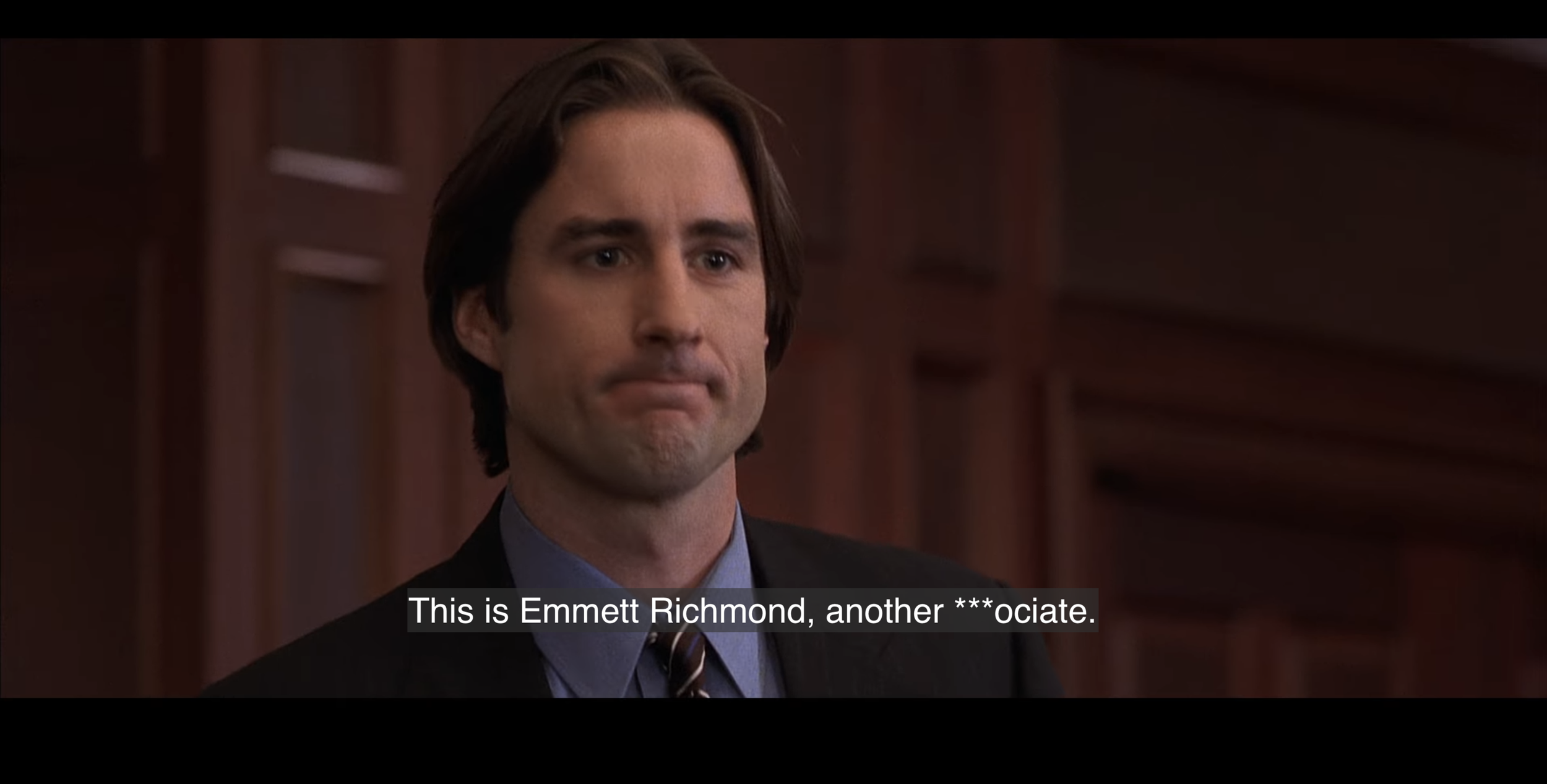

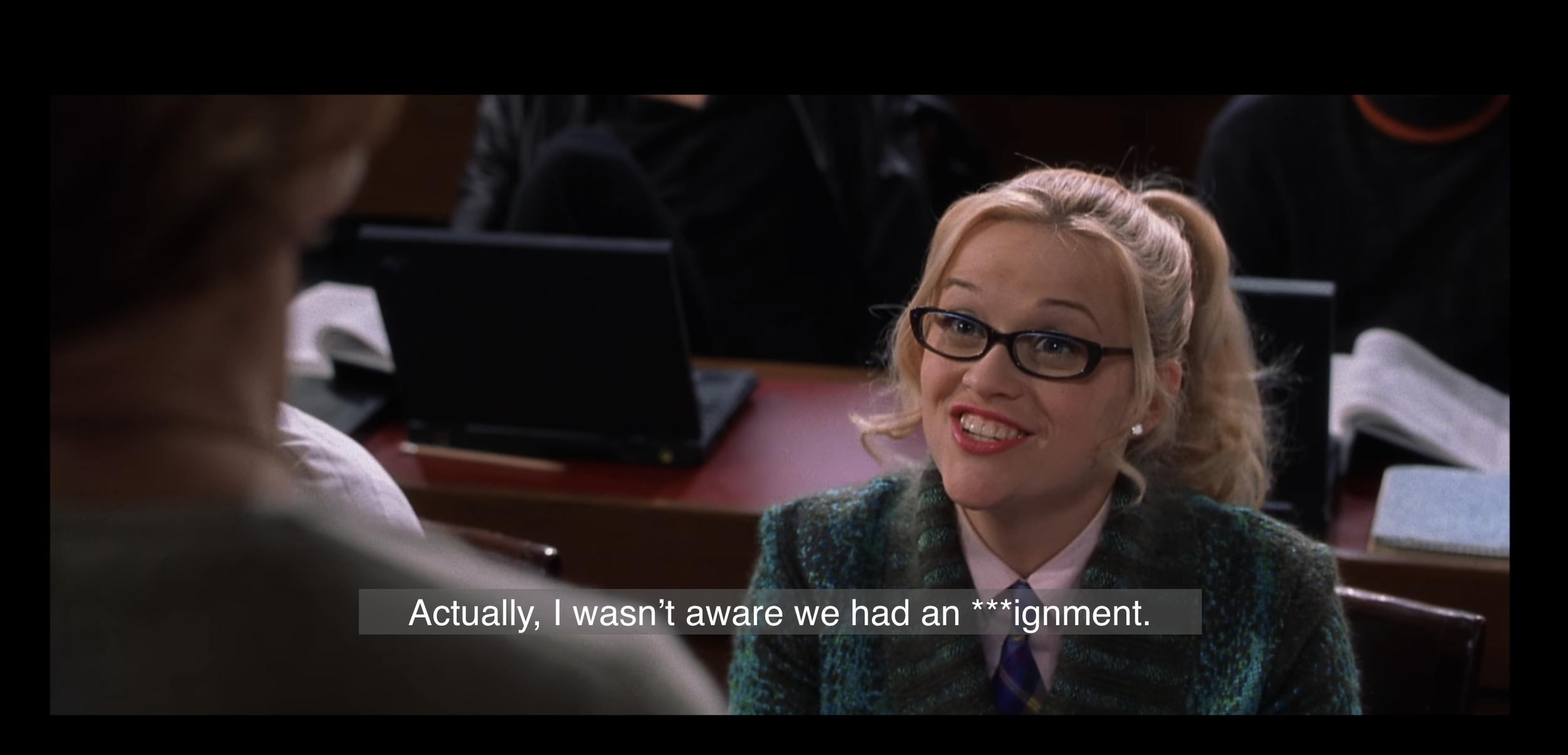
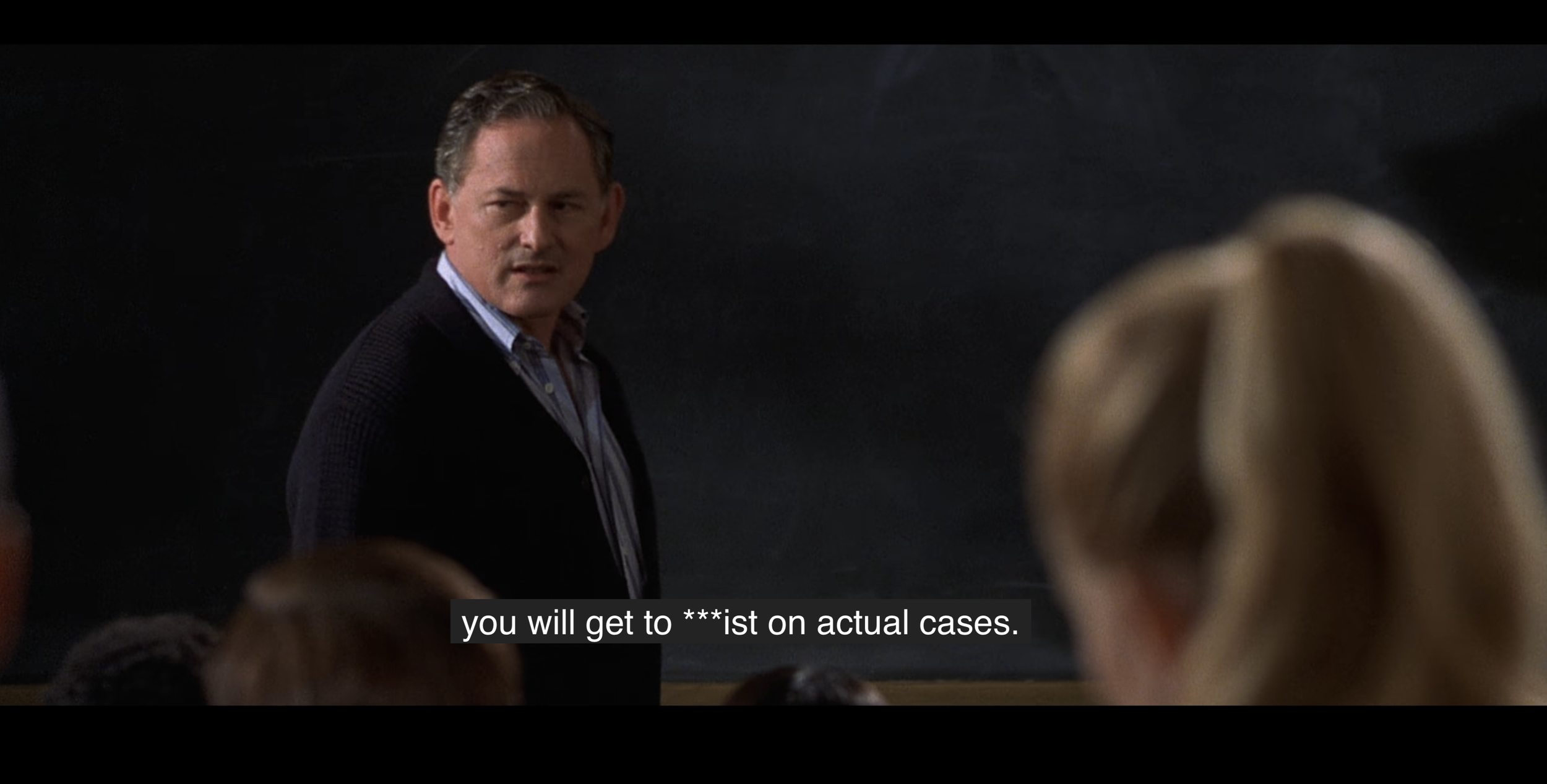
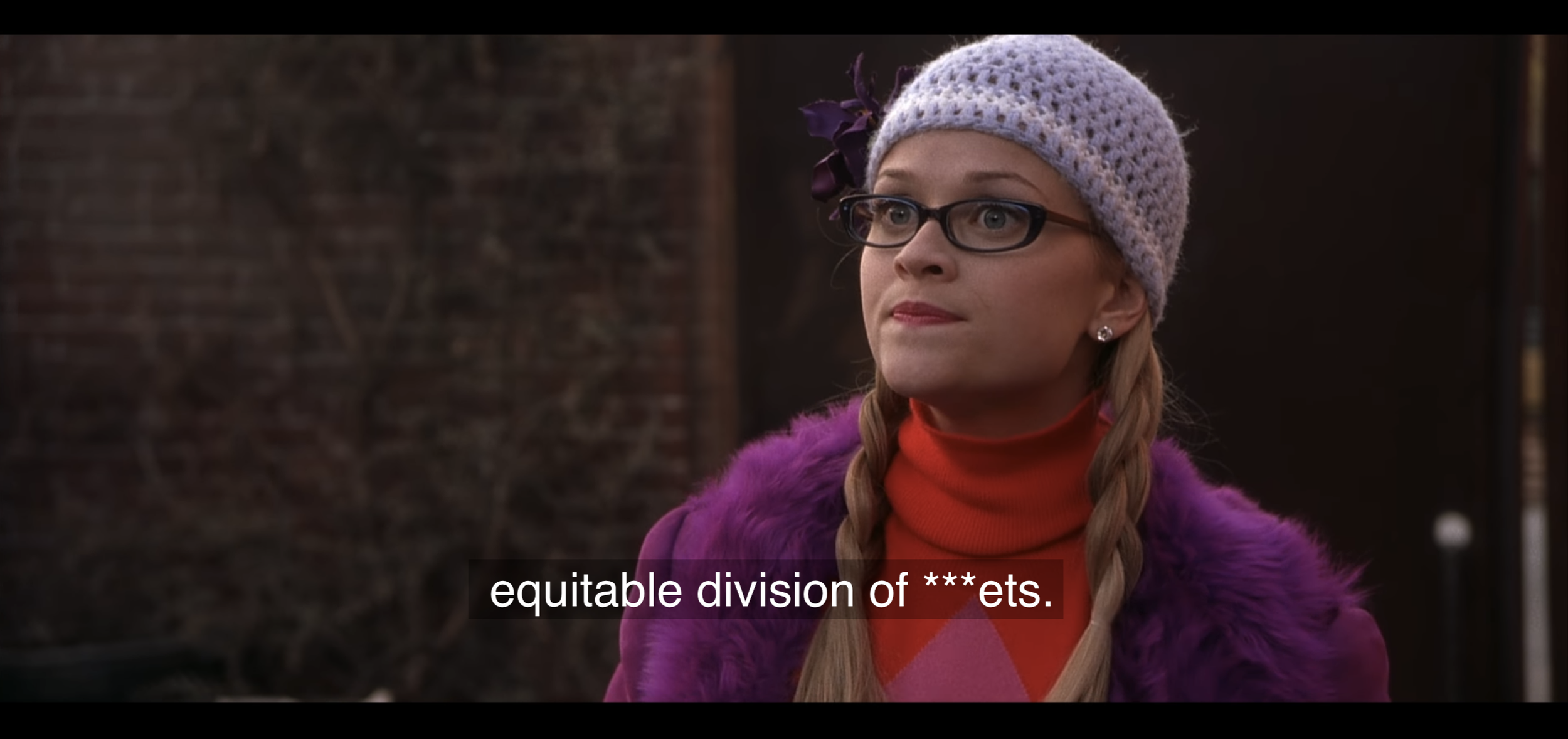
Did you deduce the missing word here?
The words spoken aloud were not bleeped out or blanked out or censored at all, so measures had been taken just to protect people who read the subtitles from the word ‘ass’. Which is not good subtitling practice. For added perplexingness, while the Legally Blonde subtitles had censored words like ‘associate’ and ‘asset’, words left intact included some slurs, as well as ‘dumbass’, and ‘ass’.
I don’t understand these priorities! But I do understand that this is an example of what is known as the Scunthorpe Problem.
The Scunthorpe Problem is a technological problem whereby content gets blocked or censored because a string of letters, an innocent string of letters, contains what would be, in other contexts, a rude word.
The reason this happens is at some point, some human has compiled a blocklist of words that, in their whole form, might be a problem: slurs, swears, that kind of thing. But of course language isn’t that simple, or at least the English language isn’t, you can’t spell ‘Scunthorpe’ without ‘Shorpe’, and programmers can’t program for every possible context every word might appear in. And the programs themselves don’t know what words are rude and what’s not, and moreover they don’t care, they’re not sentient.
The Scunthorpe Problem occurs a lot. For example, in 2020 alone, Twitter blocked hashtags about the British political troll Dominic Cummings, and Facebook kept banning users for posting about spending time at the seafront park in the southern England town of Plymouth that is called the Hoe. Hoe just means ‘high ridge’! Leave Plymouth Hoe alone! And that same year, the year of online conferencing, an online conference platform banned the word ‘bone’...from a paleontology conference.
If you have a surname like Cockburn or Hancock or Wang or Lipshitz then you probably know the Scunthorpe Problem. In South London, the Horniman Museum doesn’t receive all its emails. The Canadian magazine The Beaver, founded in 1920, changed its name in 2010 to Canada’s History so its mailouts didn’t get sent straight to spam. Even the term ‘specialist’ frequently gets blocked for containing ‘cialis’. Cialis isn’t even a swear! It’s a brand! And good luck bragging about graduating cum laude. Or trying to run a website about shitake mushrooms.
There’s also a subset of the Scunthorpe Problem, known as the Clbuttic Problem, where the word gets replaced by a more euphemistic one, resulting in messes like the Buttociated Press, the game Buttbuttin’s Creed, or clbuttical music, or the US consbreastution. That’s the Clbuttic Problem. Get it?
British place names are an absolute banquet to the hungry obscenity filters; there are whole counties with names ending in -sex. The Scunthorpe Problem could have been named after other many towns similarly affected, like the South Yorkshire town of Penistone, and Clitheroe in Lancashire, or Lightwater in Surrey - and I looked at Lightwater for ages on the map and thought, “What’s wrong with Lightwater that would get it flagged for rudes?” but eventually twigged that it’s not the ligh or the er.
Wake up, Helen!
The Scunthorpe Problem is named in tribute to the third most populous conurbation in the county of Lincolnshire, the town of Scunthorpe. In case you haven’t already clocked why Scunthorpe was chosen as the town to represent this condition, it’s because of what I’ll euphemistically refer to as the cunt-word.
The Scunthorpe Problem was diagnosed in 1996, and made the front page of the Scunthorpe Evening Telegraph, Tuesday 9 April 1996, final edition of the day.
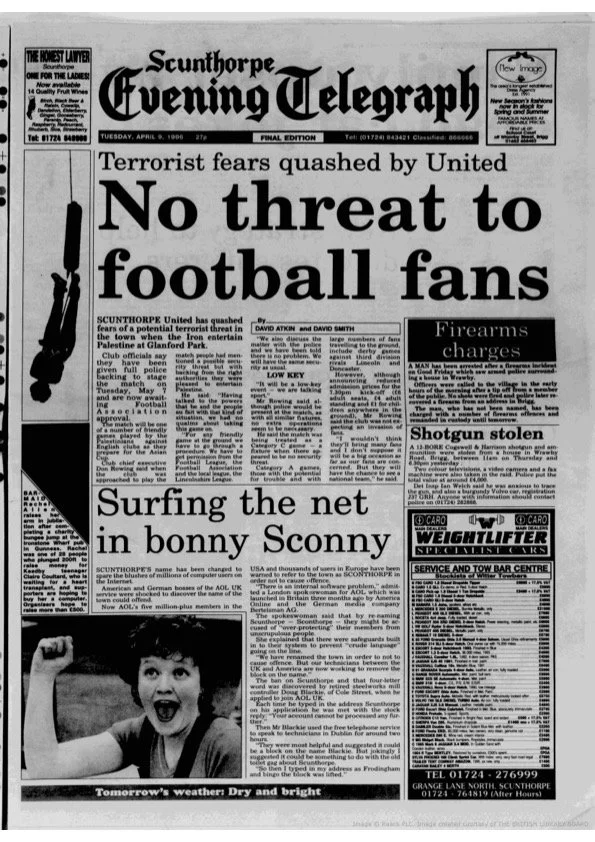
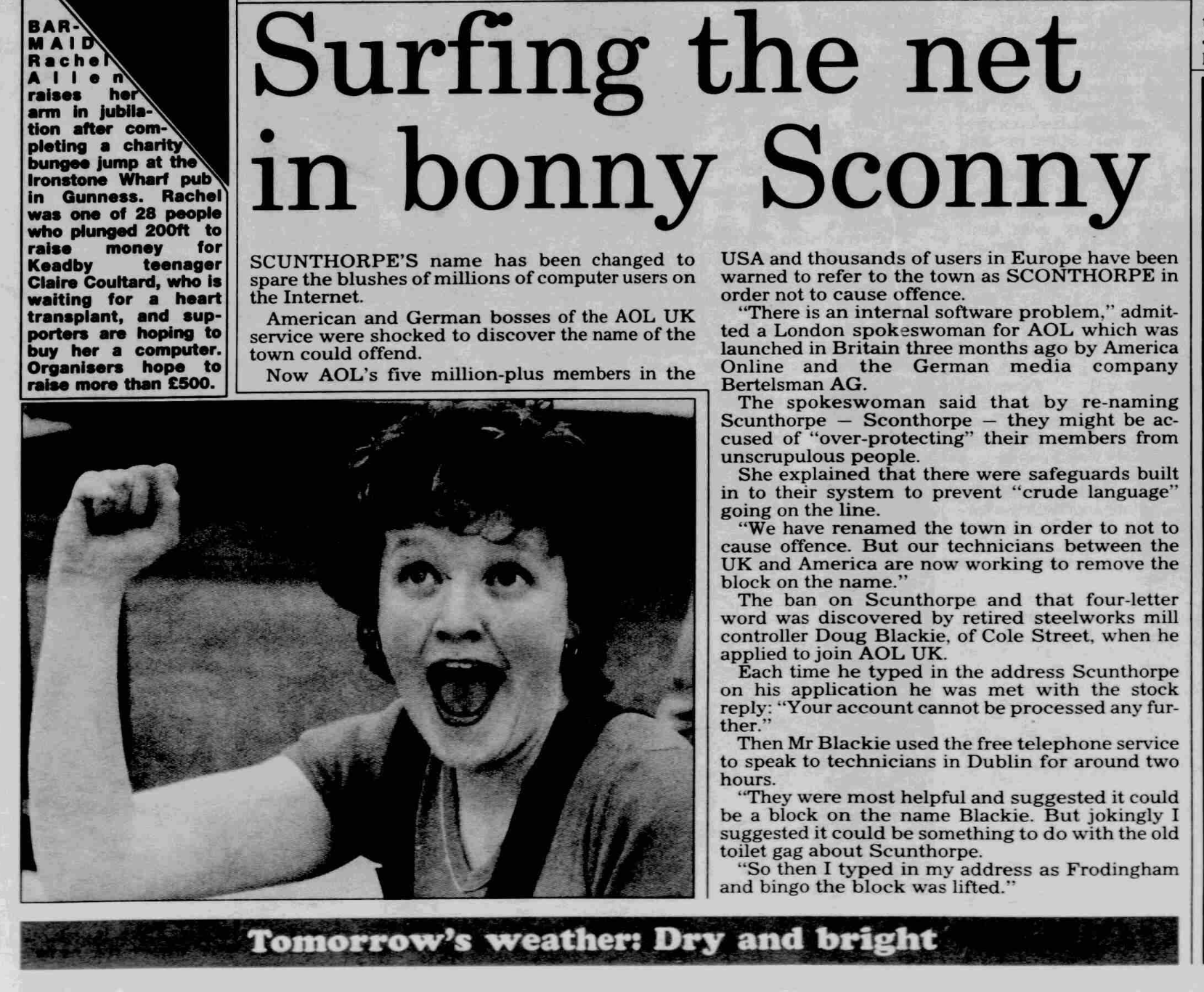
It said:
The ban on Scunthorpe and that four-letter word was discovered by retired steelworks mill controller Doug Blackie of Cole Street when he applied to join AOL UK.
Each time he typed in the address Scunthorpe on his application he was met with the stock reply: "Your account cannot be processed any further.
Doug Blackie said:
"So then I typed in my address as Frodingham and bingo the block was lifted."
AOL had only been going in the UK for three months at this time, maybe it hadn’t been faced with the profanisaurus of British placenames yet, and the company recommended people respell Scunthorpe as ‘Sconthorpe’ while they worked on fixing the problem. But this was merely the beginning of Scunthorpe’s online troubles: well into the 21st century, safesearch filters blocked the websites thisisscunthorpe.co.uk and scunthorpedistrictcatsprotection.co.uk, getting overprotective there.
Now, like Elle Woods, I have questions.
Why Scunthorpe? How did this happen? How did Scunthorpe get this name that makes it a punchline and a tech problem?
Scunthorpe is an old old place name: we know this because of the Domesday Book, which as a name sounds dramatic but the Domesday Book wasn’t actually apocalyptic, it was the record of a huge survey done in the year 1086, the king sent men out across most of England and Wales to record who held what land, and what the worth was of each piece of land and the work thereon, to make sure they paid taxes and land rents to the landowners and the king got his. Sometimes the taxes were paid in the form of what the land produced, like honey, oats, salmon, pigs, beer and eels.
Whatever happened to eel-based economics, eh? Too slippery? At the time of the Domesday book, people using eels to pay taxes and land rents were collectively paying, per year, more than 500,000 eels.
WHAT ARE THE LANDLORDS DOING WITH ALL THOSE EELS? We must be told!! And this went on for another 500 years! Maybe that was the point at which the king realised that eel money is inconvenient. It keeps slithering out of my wallet.” Idea for keeping rents down: paying in eels. “Are you raising my rent this year?” Landlord: “NO! Pay me less rent, less rent! I’m drowning here!”
Anyway, the Domesday Book is this incredible record of 268,984 households all the way back in 1086 and a lot of place names that had originated from these people’s names are still in use today. One such place name being Scunthorpe. In the Domesday Book it was written as Escumetorp. The ‘e’ at the beginning was what is known in linguistics as a ‘prosthetic E’, didn’t change the meaning, just made a consonant cluster easier for people to say if the word was a foreign import to them and they were used to a bit more vowel, as the Normans would have been then.
The middle part of Escumetorp is Skuma, which was the name of the man who was the head of the household operating on that patch of land. ‘Torp’ or ‘thorpe’ was an Old Norse word meaning hamlet or homestead or estate, so Escumetorp meant ‘Skuma’s estate’, the Domesday book was documenting that Skuma owned that land.
So the part of the word ‘Scunthorpe’ that caused all these problems 900 years later is Skuma’s name. And if Skuma was around now, I would love to ask him: “What do you make of all this?”
[Martin Austwick sings:]
I was just some guy, not an important man.
My name’s in the book ‘cause I owned a piece of land.
There’s a town there now, and the town is wreathed in shame,
But it did nothing wrong
Except it bears my name.
It’s not my fault,
Who could predict this?
Nine hundred years,
And I start causing glitches.
It’s not my fault,
I didn’t plan it.
It’s just a name,
Like James or Jeff or Janet.
It’s just a name
Like James or Jeff or Janet.
HZ: In my non-scientific opinion, in British English, ‘ass’ is not a rude word. And we’d more likely say ‘arse’ anyway, spelled A R S E, and arse probably wouldn’t be asterisked or bleeped out - the words Arsenal and arsenic tend to survive intact. The word has a long history out in the open. In Old English, the medlar fruit was called openærs, as in ‘open arse’, because of what it looked like. Bowel movements were known as ‘arse-goings’. Medieval toilet paper was called ‘arse-wisp’.
Meanwhile, historically ‘ass’, A S S, had since ancient times referred to a donkey. In 15th century English, a donkey driver was called an ‘ass man’, how things change, there’s a little piece of information to file away for whenever you need evidence to contradict someone who insists language is set in stone. In the 16th century, ass gave us the word ‘easel’, because an ass bears loads.
‘Arse’ and ‘ass’ don’t share etymology, they’re both from unrelated ancient words that respectively meant bum and donkey, but the similar pronunciation brought them together in people’s brains, like how I now have to remind myself which one is right, home in or hone in. (It’s ‘home’.)
And 250ish years ago, polite speakers started calling the animal ‘donkey’ instead of ‘ass’, to be safe. A female donkey had been a she-ass, now rebranded as a jenny or jennet.
If you want an idea of changing mores around this sort of language, there’s a play from 1684, by the Earl of Rochester, called Sodom. You can probably tell from that title that it is an intentionally provocative and saucy play, and it was probably a satire on King Charles II’s religious policies.
But in it, there are dozens of uncensored instances of the word ‘cunt’, and there are characters named Fuckadilla, Clytoris (with a Y), Bolloxinion, Cuntioratia, and Cunticula. Whereas the word they did blank out was ‘Almighty’. Because what is offensive changes a lot over time.
Anyway, like Elle Woods, sharpest mind in the Delta Nu sorority, I have questions. Why Scunthorpe? Because none of this is related to Scunthorpe, there’s no reason for Scunthorpe to contain the cunt-word at all.
In the Domesday book, Skuma’s homestead was written as Escumetorp, and in the centuries thereafter while spellings were unfixed, there were several variations such as Scumpthorpe, with a P, Scumthorpe, Sconthorpe with an O, Scomthorpe with an O M, and Skunthorpe with a K.
Lots of better options! Although the scum ones would bring their own problems - however, plenty of choices that would be no trouble.
Spam filters would have no quarrel with Scunthorpe if someone had just taken the AOL executive’s suggestion a few hundred years earlier to go with another spelling - Sconthorpe with an O, or if they really wanted the Scunthorpe sound without the inconvenience, spell it with a K.
Which would be fitting, because Skuma was spelled with a K. Skuma didn’t have a rude word for a name.
[Martin Austwick sings":]
It wasn’t rude
Way back in history.
Nobody had
To asterisk me
It wasn’t rude,
No funny business.
It’s just a name
Like Fanny, Rod or Dick is.
It’s just a name
Like Fanny, Rod or Dick is.
HZ: Now, like Elle Woods, most astute law student interning on a murder trial, I have questions. Why Scunthorpe?
The town we now know as Scunthorpe grew out of five villages: Ashby, Brumby, Crosby, Frodingham and Scunthorpe. all of which were in the Domesday book, Brumby was the land of a man called Bruni. Frodingham was another guy, Frod. There’s also the neighbourhood of Yaddlethorpe, named after Eadwulf, a name that deserves to make a comeback.
For a long time, Scunthorpe was just part of the district of Frodingham, and all these villages were pretty small, until iron ore was discovered in the area in 1859, whereupon the population swelled with people coming to work in the mines, and the villages became a town. Scunthorpe had become the biggest village, so that name got applied to the whole town.
[Martin Austwick sings:]
The town could have taken someone else’s name.
Like my neighbour Frod,
Or Bruní down the lane
Eadwulf - he was a lovely dude,
Use his name instead, then it’s not remotely rude.
I didn’t think that I’d go down in history,
My children died, grandchildren died, who’s there to miss me?
You can’t control how things will go
when your life’s ended.
I didn’t know
This is how I’d be remembered.
You never know
Just how you’ll be remembered.
You never know
How you’ll be remembered.
HZ: All this was inspired by that Legally Blonde watchalong with the Allusioverse community, so if you fancy some of that serendipity like communally being wowed by examples of the Scunthorpe Problem - which I think have been fixed now when I went back to check - then join by donating as little as $2 a month via theallusionist.org/donate. In return you also get the company of your Allusionauts, regular livestreams where I read relaxingly from my collection of unusual dictionaries, inside scoops about the making of every episode, last month a bonus livestream with my other podcast Answer Me This, and most rewarding of all, you’re funding the making of this show, which makes you A Patron of the Arts and a Generous Benefactor, whichever you prefer. Pretty cool! To become such, go to theallusionist.org/donate.
Coming up on the show, it’s words with a different number of letters season.
The subject matter of this episode does not feel super appropriate to chase with an in memoriam, but this week, a friend died, Jonathan Main. I’d known him for close to twenty years - in Crystal Palace, the London neighbourhood I lived in for a long time, he ran The Bookseller Crow, a great independent local bookshop that to me really epitomised a great local bookshop, the kind of place you’d go in without a plan and come out with a stack of books and probably some cards painted by local artists too. And the soundtrack was always excellent. I had to buy extra bookcases thanks to Jonathan’s recommendations. You can hear him on the show too, way back in the earlyish episode called Big Lit. And as well as being a keystone of the community - and invaluable source of local knowledge and gossip - Jonathan was the link between comedians, musicians, poets, novelists, memoirists, writers of all genres, and readers of course. From behind the counter in a small shop in one suburb, his influence radiated far and wide and reached thousands of people. I hope he knew just how much he mattered.
Bookseller Crow managed to survive evil landlords, COVID, awful times in local retail, scores of people browsing and then ordering what they found on the big online river-named store - “But buying from the big online river-named store is so convenient!” yeah you could stand to inconvenience yourself more, for the common good. And now Bookseller Crow has to figure out how to survive the loss of Jonathan. His copilots, his wife Justine Crow and the writer Karen McLeod, are selling books, and vouchers for books, in person or at booksellercrow.co.uk, if you want to help them out during this difficult time. And if you’re lucky enough to still have a local independent bookshop where you live, and you’re able to go to places, go in and shop there, order books from there, buy the socks and the mugs and the pencils, attend events there. There’s something about independent bookshops specifically, the communities that can grow in and around them, that is very precious and does not get recreated if or when they’re replaced by a vape shop or an estate agent with promotionally-branded minifridge, or by the big online river-named store with its malign intent.
Goodbye Jonathan, I’m one of the many many people who will miss you terribly, and I have several hundred books to remember you by, so thanks for those. And everything else.
Your randomly selected word from the dictionary today is…
hachures, plural noun: parallel lines used in hill shading on maps, their closeness indicating steepness of gradient.
Try using ‘hachures’ in an email today.
This episode was produced by me, Helen Zaltzman, on the unceded ancestral and traditional territory of the xʷməθkʷəy̓əm (Musqueam), Sḵwx̱wú7mesh (Squamish), and səlilwətaɬ (Tsleil-Waututh) Nations. The music and singing is by the singer and composer Martin Austwick; you can find his own songs at palebirdmusic.com.
Our ad partner is Multitude. To sponsor this show, so I can talk winningly and admiringly about your product or thing, get in touch with them at multitude.productions/ads.
And you can hear or read every episode, including all the other ones in Four Letter Word Season, get more information about the episode topics, and see the full dictionary entries for the randomly selected words, and find information about upcoming events such as next month’s book tour stop with that dreamboat Samin Nosrat, all at the show’s forever home theallusionist.org.
Allusionist 214. Four Letter Words: Bane Bain Bath transcript
HZ: Wolfsbane, fleabane, bugbane, dogbane, leopard’s bane. All these plants are poisonous.
MARTIN AUSTWICK: Are these poisonous to those specific creatures?
HZ: It would be amazing to discover that a plant is poisonous only to leopards.
MARTIN AUSTWICK: “I fed it to my dog fine. Pet leopard, no.”
HZ: "I just need something to keep all these leopards out my flowerbeds, but I want the squirrels to be okay."
Allusionist Apple Fest transcript
HZ: Each apple varietal had a little card with background information about the varietal's provenance and tasting notes.
HZ: “Topaz. Refreshing, sharp, sweet, mellows with age.” I mean, that's... Something for me to aspire to, but I feel I'm going the other way.
HANNAH McGREGOR: I'm definitely getting sharper and more acidic with age.
HZ: I'm getting withered and bitter without having achieved true ripeness.
HANNAH McGREGOR: Sorry, could we just check in about what it means to achieve true ripeness?
Read moreAllusionist 169 The Box transcript
SUBHADRA DAS: A guy from the UCL estates team, screwdriver, took the plaque off the wall.
HZ: That's it?
SUBHADRA DAS: That's how you dename a building. It's not difficult.
Allusionist 121 No Title transcript
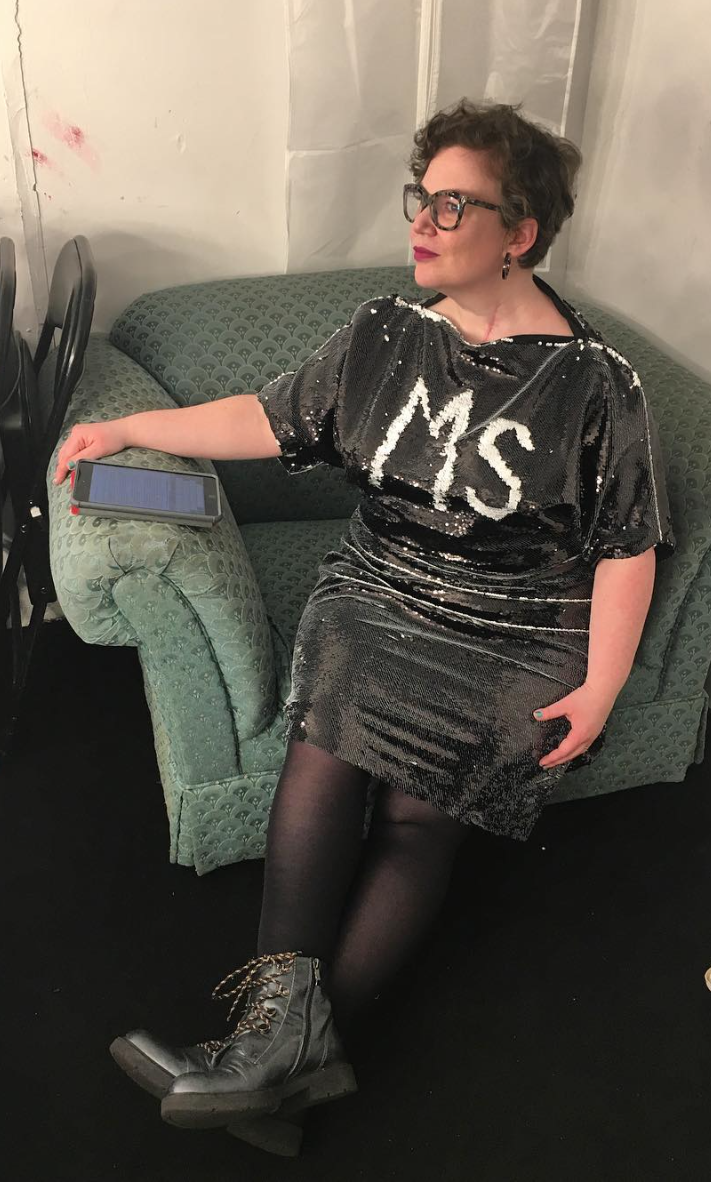
About to go onstage to perform No Title for the first time, at SF Sketchfest 2019 at the Brava Theatre in San Francisco. Photo by Martin Austwick.
The bank clerk scrolls down and down this list of titles and honorifics, this enormous list of different ways to present ourselves, and I just want an option that doesn’t reflect my marital status, because why did all the available male titles not reflect marital status whereas female ones did? And come to think of it, why do titles reflect gender anyway? Why does anything reflect gender? What is the point of gender?
I was asking a question I am not intelligent enough to answer. And I wasn’t expecting this moment, in the bank, on a seemingly trivial and pointless mission, to be my introduction to gender studies and queer theory, but you don’t necessarily get to choose the learning moments of your life.
And in case you’re sitting there thinking, “Well. If if it’s SO important to you to have a title that does not reflect your marital status or your gender, why don’t you just become a rabbi?” Well, my family lapsed HARD. None of us is becoming a rabbi. We’d never make it. They can see the bacon in our eyes.
Read moreAllusionist 89. WPM - transcript

The Guinness world record for typing speed was held by the late Barbara Blackburn. There are two kinds of typing contests: sprints, and marathons. And Barbara was a champion of both: During minute-long speed tests, Barbara could type up to 170 wpm on typewriter or, on a computer, 212 words per minute.
MARTIN AUSTWICK: 212 words per minute
HZ: And in endurance tests she could type 150wpm for 50 minutes.
MARTIN AUSTWICK: 150 words per minute, for 50 minutes
HZ: To show off her world record-breaking achievement, in 1985 Barbara was invited onto the David Letterman show, to race against the fastest typist on Letterman show staff - also called Barbara. But Barbara Blackburn sabotaged the contest.
Read more