Dinosaur mouths and dinosaur poop, psychedelic plants, feminist cookbooks, and taking a class in profanity.
Read moreAllusionist 220. Disobedience transcript
SO MAYER: Being perceived, being heard: we often think about the painful aspect of that as being misheard, being criticised, being deliberately misunderstood, being shouted down. And I've experienced all those things, of course I have. But the possibility of actually being heard is equally as painful. Because it also asks what would be the result of that, that if someone said, "Okay. I've taken on what your book is saying. What now? Back to you." And that's what a good therapist does: "I've heard you. Now what are you gonna do about it?" And then going: oh, supposedly through my educational privilege, I've been taught to take power from using language. And here I am using language and I don't feel powerful. I feel afraid and I feel ashamed, and I feel like someone's gonna hit me in the mouth.
Read moreAllusionist 217. Bread and Roses, and Coffee transcript
I was really interested in what were the stakes of calling your restaurant feminist? What were you holding yourself accountable to? What were you trying to signal to potential customers? What were you trying to say to staff and so forth?
HZ: What were the consequences? Because there were a lot of like upsides and downsides to having 'feminist' in the restaurant's name.
ALEX KETCHUM: Yeah, for sure. Some of the upsides were that you were signalling to other likeminded folks or curious folks that this could be a space for them to gather. There was an indication of the politics of the space. So it was an indication of what kind of events you might find, speakers you might find, artwork and music you might see and hear in the space.
There were also ways that people might feel more invested in the space, that they might contribute time or money or energy, or be just interested in visiting. Calling it a feminist space oftentimes was also one of the many code words, during the 1970s and 1980s, to also signal lesbian space or questioning space; or a term we might use today, but would be anachronistic at the time, as kind of like a queer women's space. So, this was a way of marking like, "Hey, you might be welcome here, your sexual orientation might be accepted, you might hear a poet you're interested in hearing," and so forth. So, there were a lot of kind of benefits in building community and interest in the space by indicating the term.
And then the downsides could also be, you know, there's bias against the word 'feminism'. Some people would feel uncomfortable with it or push back on it. There was also a concern from many of the people who founded these spaces that they might be targeted for violence. They might get rocks through the windows and so forth. Generally, that wasn't the case with a few exceptions, but there was also kind of a heightened level of fear in choosing to mark your space so explicitly.
Allusionist 181 Cairns transcript
LINDSAY ROSE RUSSELL: I don't think James Murray felt like he was alone in making the Oxford English Dictionary. I think he was keenly aware of himself as a part of a very large and many tentacled team. In a lecture he gave in 1900, he talked about every lexicographer as adding their stone to the cairn. You know, cairns like the little things when you go hiking that are piles of stones that tell you you're still on the right path. So I think Murray understood his own work as contributing to a larger lexicographical project where he was not a lone dictionary maker in the effort of dictionary making more grandly. But, I don't know; in history, I think it's easier to tell the story of a singular man. Because of course it's easier to tell the story of a singular man, as opposed to the story of thousands of people working on a single dictionary and doing all different kinds of things.
Read moreAllusionist 121 No Title transcript
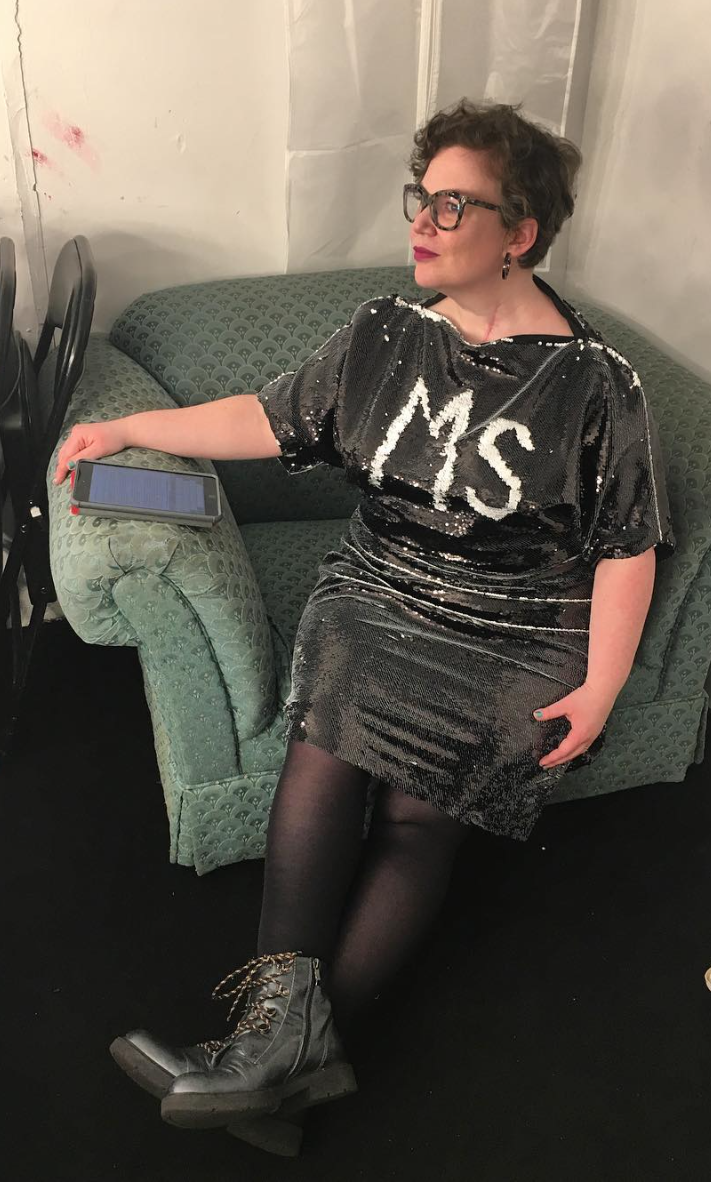
About to go onstage to perform No Title for the first time, at SF Sketchfest 2019 at the Brava Theatre in San Francisco. Photo by Martin Austwick.
The bank clerk scrolls down and down this list of titles and honorifics, this enormous list of different ways to present ourselves, and I just want an option that doesn’t reflect my marital status, because why did all the available male titles not reflect marital status whereas female ones did? And come to think of it, why do titles reflect gender anyway? Why does anything reflect gender? What is the point of gender?
I was asking a question I am not intelligent enough to answer. And I wasn’t expecting this moment, in the bank, on a seemingly trivial and pointless mission, to be my introduction to gender studies and queer theory, but you don’t necessarily get to choose the learning moments of your life.
And in case you’re sitting there thinking, “Well. If if it’s SO important to you to have a title that does not reflect your marital status or your gender, why don’t you just become a rabbi?” Well, my family lapsed HARD. None of us is becoming a rabbi. We’d never make it. They can see the bacon in our eyes.
Read more