Throughout the Draculae miniseries, about the Swedish and Icelandic translations of Dracula that played fast and loose with the original text, I've been wondering a couple of questions: why are cover versions of songs and remakes of films so normal and acceptable, whereas cover versions in book form cause such a stir? And do these Scandinavian Draculae count as fan fiction? And if not, why not? Fansplaining.com's Elizabeth Minkel explains what fan fiction can mean.
Read moreAllusionist 216. Four Letter Words: Terisk
Watching the film Legally Blonde one day with the subtitles on, numerous perfectly innocuous words were partially asterisked out, because of a technological problem I can't name here lest this episode be blocked from search results, thus becoming an example of the problem itself.
Who's to blame? A 900-year-old man from Lincolnshire. Although he didn't ask for this either.
Read moreAllusionist 209. Four Letter Words: Serving C-Bomb

Ten years ago, on the fourth ever episode of the show, I investigated why the C-word is considered a worse swear than the others. Since then - well really just in the last three years or so - there has been a huge development: the word has hit the mainstream as a compliment, in the forms of serving it and -y. Linguists Nicole Holliday and Kelly Elizabeth Wright discuss these uses of the word originating in the ballroom culture of New York City in the 1990s, and what it means to turn such a strong swear into praise.
Read moreAllusionist 208. Four Letter Words: Ffff

Welcome to four letter word season!
We're kicking off with one of the most versatile words: it can be a noun, verb, punctuation, expostulation, full sentence on its own; it can be an intensifier, an insult and a compliment... and a Category A swear. Thus, of course, content note: this episode contains many category A swears, plus some sexual references.
Read moreAllusionist 146. Survival: Today, Tomorrow part 1

The Icelandic language has remained so stable over the centuries, speakers can read manuscripts from 900 years ago without too much trouble. And when they need a new word for more recent concepts, there are committees to coin one, so that the modern Icelandic lexicon includes such things as the internet, helicopters and mansplaining. Defending the language from the encroachment of English, however, is rather more challenging.
Read moreAllusionist 102. New Rules

I don’t know exactly when or where, but at some point in the past few years, I stopped putting punctuation at the end of sentences. Why? The internet made me do it
Read moreAllusionist 97. The Future Is Now?
“There are two ways to say ‘The future is now’: you can say it optimistically, like, ‘The future is now! Isn't that cool?’ Or you could be like, ‘The future is now, and we're totally screwed.’” Rose Eveleth, of the future-envisioning podcast Flash Forward, tracks the past and present of one of her favourite phrases.
Read moreAllusionist 96. Trust
“Trust isn't a brand that you should use. It's a social glue that, when it breaks down, has really huge consequences to our lives.” Trust expert and author Rachel Botsman explains why we need to protect this word that has remained steadfast throughout its existence, but may now be too popular for its own good.
Read moreAllusionist 37: Brand It

Got a company or a product or a website you need to name? Well, be wary of the potential pitfalls: trademark disputes; pronounceability; being mistaken for a dead body...
Name developer Nancy Friedman explains how she helps companies find the right names, and why so many currently end in '-ify'.
Plus: The Allusionist's origin story, with Radiotopiskipper Roman Mars.
Read moreAllusionist 28: WLTM part I

iTUNES • RSS • MP3
Your online dating profile is the latest spin on a 300-year-old tradition of advertising yourself in order to find a spouse, a sexual partner, or someone to take care of your pigs.
Francesca Beauman, author of Shapely Ankle Preferr’d: A History of the Lonely Hearts Ad, digs into lonely hearts ads to see how British society and desires have evolved over the past three centuries.
WARNING: Some of the content is a little saucy, but not, like, swimming in sauce.
READING MATTER:
Reviews of hundreds of different dating sites? You got it.
I love reading the Blind Dates in the Guardian each Saturday, and The Guyliner’s dissection thereof shortly afterwards.
Atlas Obscura tests the Victorian seduction technique of reading aloud.
Not so much a lonely heart ad as a curious soul ad, but it resulted in one of the most intriguing books I’ve ever read: The Life Swap by Nancy Weber. Read about it here (NB spoilers).
Warlock: offensive term?
The transcript of this episode is at theallusionist.org/transcripts/wltm-i.
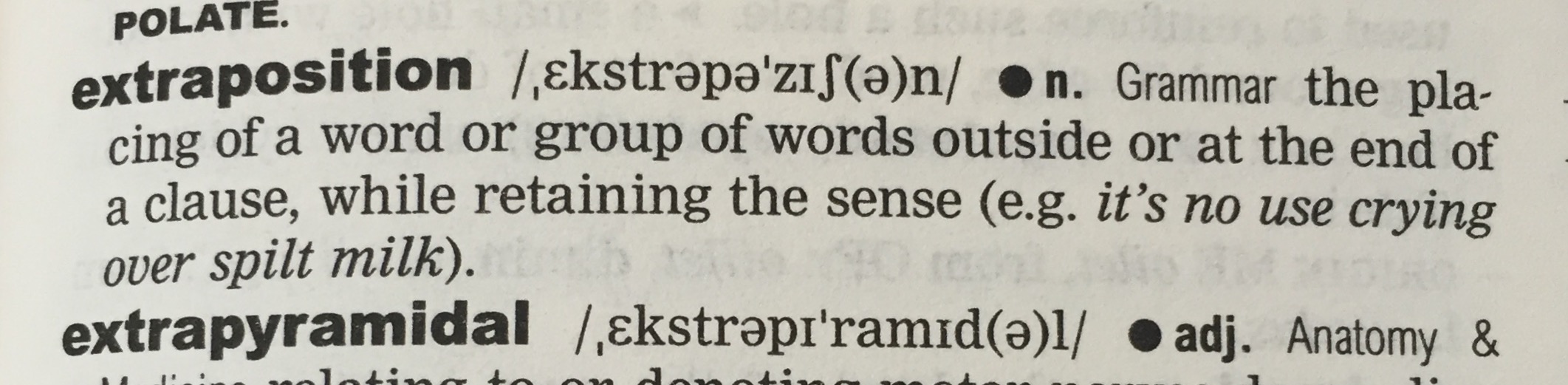
RANDOMLY SELECTED WORD FROM THE DICTIONARY:
extraposition
CREDITS:
Find Francesca Beauman at francescabeauman.com and buy her books, including the excellent Shapely Ankle Preferr’d, from your usual book-buying places.
This episode was produced by me, Helen Zaltzman.
Martin Austwick provided all the music.
Matthew Crosby provided his voice.
Allusionist listeners provided their dating profiles, for which I am extremely grateful.
WLTM you at facebook.com/allusionistshow, twitter.com/allusionistshow and twitter.com/helenzaltzman.
This is a two-parter, and the second half is an absolute belter, so return next week to hear it.
