You know what's an absolutely pesky kind of word to define in a dictionary? Colour names. A passel of lexicographers spent years - decades, even - trying different ways to describe colours in words for Webster's Third International Dictionary. It was such a huge, complicated effort that it took twelve years for former Merriam-Webster lexicographer Kory Stamper to write a book about it.
Read moreAllusionist 213. Four Letter Words: Dino
The latest four letter word of Four Letter Word season is dino. 'Dinosaur' is derived from Greek 'terrible lizard', and they could have called it 'whopping great lizard' or 'sublime lizard' or 'hey cool lizard', but no. TERRIBLE.
Professor Hannah McGregor of Material Girls podcast and author of the book Clever Girl: Jurassic Park explains humans' relationship with language for dinosaurs, and why 'terrible' might be a perfect choice.
Read moreAllusionist 209. Four Letter Words: Serving C-Bomb

Ten years ago, on the fourth ever episode of the show, I investigated why the C-word is considered a worse swear than the others. Since then - well really just in the last three years or so - there has been a huge development: the word has hit the mainstream as a compliment, in the forms of serving it and -y. Linguists Nicole Holliday and Kelly Elizabeth Wright discuss these uses of the word originating in the ballroom culture of New York City in the 1990s, and what it means to turn such a strong swear into praise.
Read moreAllusionist 205. Lexicat, part 2: now with added Dog
In Lexicat part 1, we met the author Mary Robinette Kowal and her cat Elsie, and learned about how they communicate via a set of buttons programmed with words. In part 2, two talking dogs, Bastian and Parker - and their humans, Joelle Andres and Sascha Crasnow - join us too, and explain how they discovered some very unexpected things about what their animal companions are thinking and feeling thanks to the buttons, and how they changed the ways they communicate with other humans too. And animal behaviour expert Zazie Todd gives us some tips for interpreting cats’ and dogs’ body language.
Read moreAllusionist 204. Lexicat, part 1

Elsie the cat has a set of 120 buttons programmed with words. She uses them to lie, swear, apologise, express grief and frustration and love to her human, the author Mary Robinette Kowal, who talks about what's involved in learning to communicate via language buttons with companion animals. And animal behaviour expert Zazie Todd explains how animals might be interacting with human language.
Read moreAllusionist 145. Parents

When you're trans and pregnant, some of the vocabulary of pregnancy, birth and parenting might not fit you. In face, some of it might not even work for people of ANY gender. Trans parents Freddy McConnell and CJ talk about gender-additive language, inclusive for women and other genders, and about how in English law, the word 'mother' becomes semantically very complicated indeed.
Read moreAllusionist 79. Queer

Strange or obtuse; a stinging homophobic slur; a radical political rejection of normativity; a broad term encompassing every and any variation on sexual orientation and gender identity: the word 'queer' has a multifarious past and complicated present. This is just a fraction of it.
Tracing the word's movements are Kathy Tu and Tobin Low from Nancy podcast, Eric Marcus from Making Gay History, and historian and author Amy Sueyoshi, with Jonathan Van Ness from Queer Eye.
Read moreAllusionist 60: Zillions

They look like numbers. They sound like numbers. You kinda know they are numbers. But they're not actually numbers. Linguistic anthropologist Stephen Chrisomalis explains what's going on with indefinite hyperbolic numerals like 'zillion', 'squillion' and 'kajillion'.
Read moreAllusionist 44: This Is Your Brain On Language
What is your beautiful brain up to as you comprehend language?
Read moreAllusionist 13: Mixed Emojions

iTUNES • RSS • MP3
Emoji allow communication without words. Could emoji be the universal language of the 21st century? Matt Gray and Tom Scott, founders of the emoji-only messaging platform emoj.li, talk through the pitfalls; and History Today's Dr Kate Wiles finds the 500- and 5,000-year-old precedents for emoji.
CONTENT WARNING: this episode contains one category B swear word, plus references to penises growing on trees.
ADDITIONAL READING:
There is a transcript of this episode here.
Keep up to date with all matters emojional at Emojipedia.
Read the Luttrell Psalter. Or Emoji Dick, if you must. (Try before you buy.)
It should have been a portent of Things To Come that at age six, my favourite of the Just So Stories was the one about the alphabet being invented. It's Rudyard Kipling's own spin on cuneiform, pretty much.
Why the interrobang never really took off. It's the "That's so fetch!" of punctuation.
Your summer beach read: Unicode.
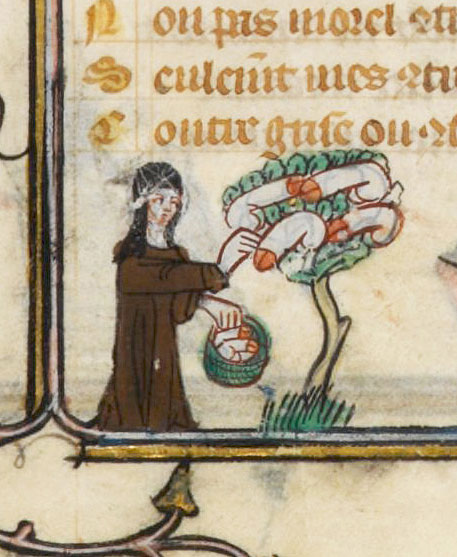
The more medieval marginalia you find, the better they get. Here are some choice cuts, and there are many more at Got Medieval; read Kate Wiles herself on the topic; read an explanation as to why so many involve knights fighting snails; or if you can't be bothered to read, just watch the video I made for you:
RANDOMLY SELECTED WORD FROM THE DICTIONARY:
kloof

CREDITS:
Dr Kate Wiles is contributing editor at History Today and appears on their podcast.
Matt Gray and Tom Scott brought the emoji-only messenger Emoj.li to life and now they're putting it to death.
All the music in this episode is by Martin Austwick. Hear and/or download more at thesoundoftheladies.bandcamp.com.
This episode was produced by me, Helen Zaltzman. Thanks very much to the Soho Theatre in London for letting me record there.
Find me at facebook.com/allusionistshow, twitter.com/allusionistshow and twitter.com/helenzaltzman.