• Episodes
  • Listen
  • Transcripts
  • Tranquillusionist
  • Events
  • Lexicon
  • Donate
  • Contact
  • Merch
Menu

The Allusionist

Street Address
City, State, Zip
Phone Number
A PODCAST ABOUT LANGUAGE
BY HELEN ZALTZMAN

Your Custom Text Here

The Allusionist

  • Episodes
  • Listen
  • Transcripts
  • Tranquillusionist
  • Events
  • Lexicon
  • Donate
  • Contact
  • Merch

Allusionist 215. Two-Letter Words

August 26, 2025 The Allusionist

Listener Erica commented: "Perhaps an idea for a bonus ep of Four Letter Word season would be one on two-letter words: there’s an established list that Scrabble nerds end up memorizing, and it’s full of weirdness." In fact, there are TWO established lists, NASPA, the North American Scrabble Players Association, which has currently 107 two-letter words, and Collins Scrabble Words, formerly known as SOWPODS, used by the rest of the world and contains at present 127 two-letter words.

And this episode, we're going to hear all those two-letter words. If you don't agree with their Scrabbular validity, don't blame me! Some of the inclusions were a surprise, frankly!

Read more
In episodes, Tranquillusionist Tags words, language, lexicography, etymology, lexicon, history, vocabulary, two letter words, Scrabble, games, board games, CSW, Collins Dictionary, Collins Scrabble Words, North American Scrabble Players Association, NASPA, SOWPODS, dictionaries, Ancient Rome, Ancient Egypt, souls, asses, coin, pronouns, Hawaiʻi, Hawaiʻian, ʻokina, birds, musical notes, scale, solfège, Māori, Odin, animals, yaks, portmanteau, portmantNO, hesitation, ad lib, tracasseries, yattle, Tranquillusionist

Allusionist 214. Four Letter Words: Bane Bain Bath

August 13, 2025 The Allusionist

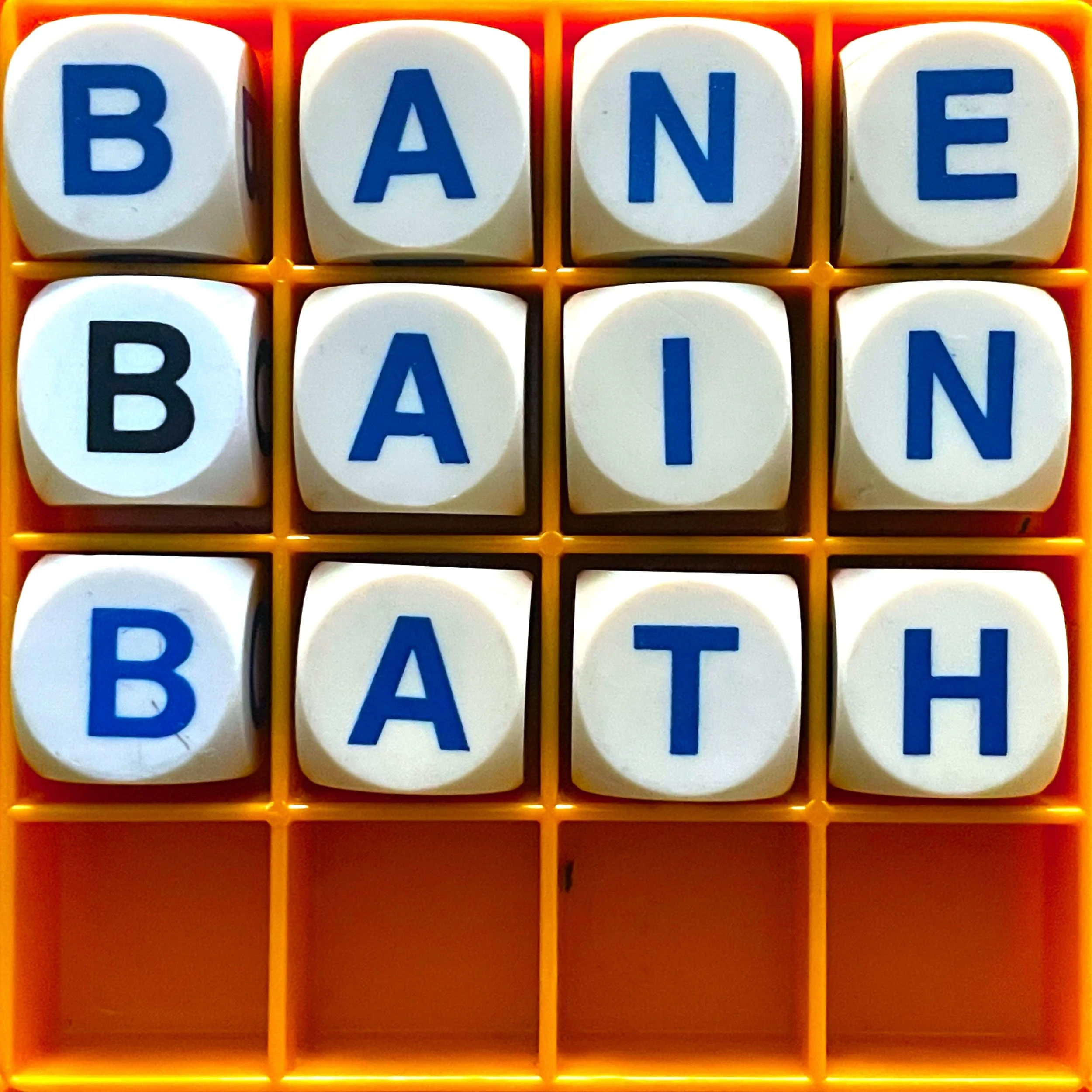
For today’s instalment of Four Letter Word season, we’re hopping from ‘bane’ to ‘bain’ to ‘bath’, via poison gardens, doll’s eyes, alchemists, placentas and waterborne curses.

Read more
In episodes, Four Letter Words Tags etymology, lexicon, society, culture, words, language, history, vocabulary, four letter words, Martin Austwick, Batman, Bath, Somerset, baths, Ancient Rome, Roman Empire, ancient Britain, Celts, Celtic, sacred spring, curse tablets, curses, cursing, deities, gods, water, plants, poison, Ancient Egypt, Egyptian, Cato, recipes, cakes, hollandaise sauce, cooking, cookery, food, medicine, alchemy, wolfsbane, woke, doll’s eyes, leopards, expressions, butterflies, mariposa, marigold, flowers, enemies, dung, grievances, UNESCO, heritage, lead, ancient history, theft, punishment, autobahn, bain marie, bane, manticore, placenta

Tranquillusionist: Ex-Constellations

September 26, 2024 The Allusionist

This is the Tranquillusionist, in which I, Helen Zaltzman, give your brain a break by temporarily supplanting your interior monologue with words that don't make you feel feelings. Note: this is NOT a normal episode of the Allusionist, where you might learn something about language and your brain might be stimulated. The Tranquillusionist's purpose is to soothe your brain and for you to learn very little, except for something about Zeus's attitude to bad drivers.

Today: constellations that got demoted into ex-constellations. Featuring airborne pregnancy, cats of the skies, and one of the 18th century's most unpopular multi-hyphenates.

Read more
In episodes, Tranquillusionist Tags etymology, vocabulary, history, serene, serenity, ASMR, calm, calmness, meditation, sleep, mood, Tranquillusionist, relaxation, tranquil, tranquillity, stars, sky, firmament, celestial, Ptolemy, asterism, IAU, International Astronomical Union, Hadrian, dogs, technology, printing press, Gutenberg, Uranus, William Hershel, Johann Bode, Zeus, goats, crabs, myth, Greek myth, Ancient Rome, Romans, Latin, Greek, gods, deities, saints, relics, Saint Veronica, Jesus, Ancient Greece, astronomy, astronomers, Cerberus, John Hill, Henry Fielding, beeves, beef, feuds, Jerome Lalande, cats, sycophancy, royals, monarchy, monarchs, King Charles II, Prussia, King George III, King Charles I, scepters, sceptres, slugs, login, log line, log book, worms, constellations, asterisms, Phaeton, Helios, Hercules, reindeer, Mapertuis, Alessandro Volta, Jacques Cassini, Capra, Titans, telescopes, Maximilian Hell, conception, pregnancy, navigation, pangolin, ventifact, space, space words

Allusionist 182. Siblings of Chaos

September 24, 2023 The Allusionist

Lexicographer, author and Dictionary Corner resident Susie Dent has been studying words to make us feel happy. She brings etymologies concerning cows, gas, guts and fat, of bellies and breathing and bonanzas. And some that came from the high seas and aren't made up!

Read more
In episodes Tags etymology, words, language, lexicography, lexicon, vocabulary, history, dictionaries, dictionary, Susie Dent, nitwit, breathing, respiration, Paracelsus, JB Van Helmont, Dutch, JR Tolkien, reversal, semantic bleaching, maritime, false etymology, sea, sailors, fat, tallow, cows, cattle, meat, animals, organs, mining, mines, may, ruthless, discombobulate, recombobulation, deep dives, emotional granularity, mubblefubbles, belly, bellies, nits, rivers, hibernation, heart, guts, intestines, divination, plagues, religion, Paganism, Christianity, augers, auspex, JRR Tolkien, susurrus, fellow, cheap, Cheapside, trade, market, Romans, Ancient Rome, Egypt, posh, CANOE, dote, auspicious, bellycheer, bonanza, catastrophe, courage, derelict, derive, digs, dismay, eucatastrophe, flotsam, fond, gas, hibernacle, inauguration, inspire, inwit, jetsam, lagan, latibulate, nice, outwit, panning out, perspire, pluck, rival, silly, slush fund, spifflicate, spirit, suspire, taghaelm, vegetable

Allusionist 130. Valentine

February 14, 2021 The Allusionist
A130 Valentine logo.jpeg

St Valentine's name may nowadays be all over the romance-related merch for 14 February, but he was also the patron saint of beekeepers, epilepsy and plagues. Let's get to know this multi-hyphenate saint a bit better.

Read more
In episodes Tags words, language, linguistics, education, comedy, entertainment, society & culture, arts, literature, etymology, lexicon, vocabulary, St Valentine, St Agatha, saints, martyrs, sainthood, patron saint, patronage, love, romance, Valentine’s Day, Ancient Rome, Rome, Roman Empire, Roman emperors, February, purification, sacrifice, religion, paganism, Christians, Christianity, plague, epilepsy, birds, Lupercalia, Lupercali, priests, Chaucer, Parliament of Fowls, courtly love, rituals, goats, rhyton, mud month

Allusionist 123. Celebrity

October 10, 2020 The Allusionist
A123 Celebrity logo.jpg

Celebrity used to mean a solemn occasion; X factor was algebraic; and fame was a huge terrifying Godzilla-like beast with many many tongues.

Here to try define celebrity and fame are historian Greg Jenner of the podcast You’re Dead To Me, Lindsey Weber and Bobby Finger of Who? Weekly podcast, and writer, podcaster and videomaker Hank Green.

Read more
In episodes Tags words, language, linguistics, education, comedy, entertainment, society & culture, arts, literature, etymology, lexicon, vocabulary, Greg Jenner, Hank Green, Who Weekly, Lindsey Weber, Bobby Finger, celebrity, celebrities, fame, famous, notoriety, notorious, renown, respect, bad fame, infamous, infamy, reputation, skimmington, history, Lord Byron, Marilyn Monroe, David Attenborough, David Schwimmer, Schwimfans, Richard Nixon, Brian Austin Green, Angelina Jolie, Ovid, Julius Caesar, Virgil, Chaucer, Godzilla, Aeneid, Metamorphoses, Fama, poetry, religion, attention, stardom, stars, stellified, charisma, kleos, akleos, glory, economics, media, tabloids, magazines, paparazzi, Whos, Thems, Herostratus Syndrome, Herostratus, psychology, Ancient Rome, Ancient Greece, Romans, Greeks, Romantic period, theatre, theater, movies, film, 18th century, 19th century, private lives, gossip, jobs, careers, goddesses, gods, deities, Greek deites, Pheme, infamia, law, legal, King Edward VI, Book of Common Prayer, sinners, Temple of Ephasus, meteorology, comets, celestial, Edmund Kean, Charises, Three Graces, X factor, X, oomph, oomphish, Ann Sheridan

Allusionist 98. Alter Ego

April 25, 2019 The Allusionist
A98 Alter Ego logo.jpg

Today: three pieces about alter egos, when your name - the words by which the world knows you - is replaced by another for particular purposes.

  • How did John Doe come to be the name for a man, alive or dead, identity unknown or concealed in a legal matter? Strap in for a whirlwind ride into some frankly batshit centuries-old English law.

  • At their first bout of the 2019 season, the London Roller Girls talk about how they chose their roller derby names - or why they chose to get rid of one.

  • The 1930s and 40s were a golden age for detective fiction, which was also very popular and lucrative. Yet writing it was disreputable enough for authors to hide behind pseudonyms.

Read more
In episodes Tags words, language, linguistics, education, comedy, entertainment, society & culture, arts, literature, Helen Zaltzman, etymology, lexicography, alter egos, embouchure, John Doe, Jane Doe, Mary Major, Richard Roe, law, legal, history, legal history, anonymity, anonymous, pseudonyms, names, ejectment, property, tenants, land, placeholder names, court case, courtroom, British law, plaintiffs, defendants, Ancient Rome, Romans, Latin, NN, Numerius Negidius, Aulus Agerius, JK Rowling, dead bodies, corpses, unknown, unidentified, Roe v Wade, Doe v Bolton, skating, roller derby, puns, punning, jokes, wordplay, sports, sport, London Roller Girls, LRG, Beyonce, Sasha Fierce, athletes, fonts, Helvetica, novels, fiction, detective fiction, Caroline Crampton, mystery novels, swears, Cecil Day-Lewis, Agatha Christie, Nicholas Blake, pen names, Robert Galbraith, Shedunnit, Detection Club, snobbery, genres, Elena Ferrante, unmasking, Mary Westmacott, books, married names, Max Mallowan

Allusionist 42+43. Survival: The Key rerun

May 4, 2018 The Allusionist
The Key logo.jpg

To accompany the current Allusionist miniseries Survival, about minority languages facing suppression and extinction, we're revisiting this double bill of The Key episodes about why languages die and how they can be resuscitated.

The Rosetta Stone and its modern equivalent the Rosetta Disk preserve writing systems to be read by future generations. But how do those generations decipher text that wasn't written with the expectation of requiring decipherment?

Features mild scenes of linguistic apocalypse.

Read more
In episodes, Survival Tags language, language death, language extinction, dead languages, minority languages, Rosetta Stone, Rosetta Project, Rosetta Disk, Latin, Romans, Ancient Rome, British Museum, Long Now Foundation, past, future, history, preservation, interpretation, decipher, translate, stele, Egypt, Egyptian, Napoleon, archaeology, multilingual, bilingual, Oscan, ancient, extinction, Italy, graffiti, ancient languages, monolingual, Survival, survival

Allusionist 68. Curse Soup

November 24, 2017 The Allusionist
A68 Curse Soup logo.jpg

Somebody has really ticked you off. You're all steamed up inside and you want to vent that rage using words, but you don't want to confront them directly because you're either too polite or too cowardly. So do you:

A. Subtweet them.
B. With your finger, scrawl an insulting message into the dirt on their car.
C. Get a small sheet of lead, scratch into it a message cursing your enemies, roll it up and throw it into your nearest sacred spring?

Oh, I forgot to mention that it's 1700-2000 years ago and you're living in the Ancient Roman Empire, so the answer is C.

Read more
In episodes Tags words, messages, enemies, curses, Ancient Rome, ancient Britain, Celtic, Celts, Bath, Roman baths, sacred, springs, water, deities, gods, goddesses, Sulis, Minerva, Somerset, England, history, English history, Aquae Sulis, Phoebe Judge, Lauren Spohrer, Leslie Scott

Allusionist 57: AD/BC

June 2, 2017 The Allusionist

There’s a small matter I trip over regularly in the Allusionist:

Dates.

Not the fruit.

BC and AD, Before Christ and Anno Domini ('the year of the Lord' ('the Lord' also being Christ)).

How did Jesus Christ get to be all up in our system of counting the years?

Read more
In episodes Tags words, language, religion, religious, Jesus Christ, history, Rome, Romans, Ancient Rome, Julius Caesar, days, weeks, months, years, time, calendar, idus, ides, nones, kalends, calends, France, French Revolution, AD, BC, Common Era, ACE, BCE, Christian, Christianity, standardization, standardisation, globalisation, eras, epochs, dates, dating, Dionysus Exiguus, railways, Ear Hustle, Doing Time, Easter, Gregorian Calendar, Julian Calendar, papal, pope, Gregory XIII, intercalation, intercalary, leap day, leap month, leap year, Mercedonius, holocene Era, Cesare Emiliani, Vulgar Era
11 Comments
Older Posts →
Allusionist Patreon
Featured
Allusionist 233. Phobia

'Phobia' gets used for anything from a mild aversion to a debilitating anxiety response to various forms of bigotry. Deboki Chakravarti and Sam Jones of the podcast Tiny Matters join to consider the term from its comedic origins with one of the founding fathers of the USA, via rabies and Greek deities, to its role in their lives today.

CONTENT NOTE: we’re not trying to stoke anyone’s phobias, but we do discuss some common phobia-inducers, including snakes, germs and small holes, and there’s a brief mention of tarantulas. There’s also talk about OCD and rabies.

Read more →
Allusionist 232. Vega

What do you call yourself if you're a part-time vegetarian? What petty linguistic things would you change? And what do you do if people gripe at you if you say that you are bi or pan? To answer these questions from the Allusionist mailbag are esteemed alumsionists: Hrishikesh Hirway and Samin Nosrat of Home Cooking podcast; academic and author Alex Ketchum; lexicographer Kory Stamper; and linguist Lauren Gawne of Lingthusiasm podcast.

Read more →
Tranquillusionist: cheesy cheesybobs

This is the Tranquillusionist, in which I, Helen Zaltzman, say a series of words to relax your mind, replace a hectic interior monologue, maybe lull you to sleep, hopefully quell the mental uproar just for a little while.

Today: nicknames for woodlice AKA rolypoly bugs AKA slaters AKA all these other things; and a list of cheeses from Great Britain and Ireland.

Read more →
78AF926C-7878-4567-A87F-13CFF415B647_1_105_c.jpeg
sorry lads, we're getting bad ads

TL;DR version:

  • For the show's financial survival (hopefully), over the next few weeks I'm having to switch on programmatic advertisements. This means, for the first time in the show's nearly 12-year existence, you may be subjected to ads that are not voiced, scripted and individually approved by me.

  • If you would prefer to listen to the show without ads in it, patreonise the show at the Gravy, Wedge or Check tiers, which include the perk of an ad-free RSS feed.

Click through to read the rest of the post about why I’m doing this thing I don’t want to do.

Read more →
Allusionist 231. Lingthusionist

“Linguistics and language is such a good mechanism for being curious,” says Lauren Gawne, linguistics prof, author of the book Gesture, and cohost of the podcast Lingthusiasm. I'm in vacation mode (although not on actual vacation alas), so today's episode is a fun chat with our nice pal about making language podcasts, the firey digestive punishments for linguistics researchers, working in reality television, and cute tame nouns versus scary intimidating verbs.

Read more →
Allusionist 230. Draculae part 4: Transformation

Throughout the Draculae miniseries, about the Swedish and Icelandic translations of Dracula that played fast and loose with the original text, I've been wondering a couple of questions: why are cover versions of songs and remakes of films so normal and acceptable, whereas cover versions in book form cause such a stir? And do these Scandinavian Draculae count as fan fiction? And if not, why not? Fansplaining.com's Elizabeth Minkel explains what fan fiction can mean.

Read more →
Allusionist 229. Draculae part 3: Hunting Down the Count

Many mysteries accompany the revelations that Powers of Darkness, the Icelandic and Swedish versions of Dracula, are not direct translations of Bram Stoker's original, but stories that significantly differ in character names, plot and runtime. Like: did Bram Stoker write it himself, to publish some raunchy content that British censors would forbid? Was Powers of Darkness based on his early drafts? And did he really not copyright Dracula in the USA was that a deliberate ruse? Welllll... brace yourself for ole thrill-destroyer Zaltzman to pop your balloons of excitement.

Read more →
queer playlist
Read more →
Allusionist 228. Draculae part 2: Surprises in the Vaults

Happy World Dracula Day to all who celebrate!

This is the second episode of the Draculae miniseries, about a literary mystery which came to me via a meme: “Someone translated Dracula into Icelandic, and it took over 100 years for anyone to point out he just made a fanfic rewrite of what he wanted the story to be.”

In Draculae part 2, Ásgeir Jónsson explains how he got that Icelandic adaptation of Dracula back into print, to little fanfare - but then Dutch scholar Hans Corneel de Roos set about making an English translation. Following that: like me, Will Trimble also got meme-struck, and that propelled him to get a translation of the Swedish version that begat the Icelandic one.

Before listening to this, check out the first episode of the Draculae miniseries explaining the three versions of Dracula: Dracula published by Bram Stoker in 1897; the Icelandic version Makt Myrkranna by newspaper editor Valdimar Ásmundsson, serialised in his newspaper Fyallkonan in 1900-1901; and the Swedish version Mörkrets makter by an author known only as A—e, and serialised in a couple of Swedish newspapers 1899-1900.

Read more →
Allusionist 227. Draculae part 1: Enter the Castle

A literary mystery came to me via a meme.

Read more →
Allusionist 226. Suburbia

"The word ‘suburbia’ sort of evokes a very fixed idea of a place that is identikit, that all suburbs are the same, that within the suburb everything is the same, that all people are the same, all experiences are the same," says social historian and author John Grindrod. "I think it has this kind of flattening-out facility, that word, that isn't true."

Read more →
Allusionist 225. Hues

You know what's an absolutely pesky kind of word to define in a dictionary? Colour names. A passel of lexicographers spent years - decades, even - trying different ways to describe colours in words for Webster's Third International Dictionary. It was such a huge, complicated effort that it took twelve years for former Merriam-Webster lexicographer Kory Stamper to write a book about it.

Read more →
Allusionist 224. Cosmic Hairball

Pack your oxygen tank, we're going up to space. There’s a lot of etymology up there.

Read more →
Allusionist 223. Bonus 2025
Read more →
Allusionist 222. A Christmas Carol

Today, we read the novelisation of The Muppet Christmas Carol, also known as the 1843 festive lit hit A Christmas Carol by Charles Dickens.

Read more →
Creative Commons Licence
The Allusionist by Helen Zaltzman is licensed under a Creative Commons Attribution-NonCommercial-NoDerivatives 4.0 International License.